„Dimitrie Cupovski“ 13, 1000 Skopje +38923244000 ic@mchamber.mk
„Dimitrie Cupovski“ 13, 1000 Skopje +38923244000 ic@mchamber.mk
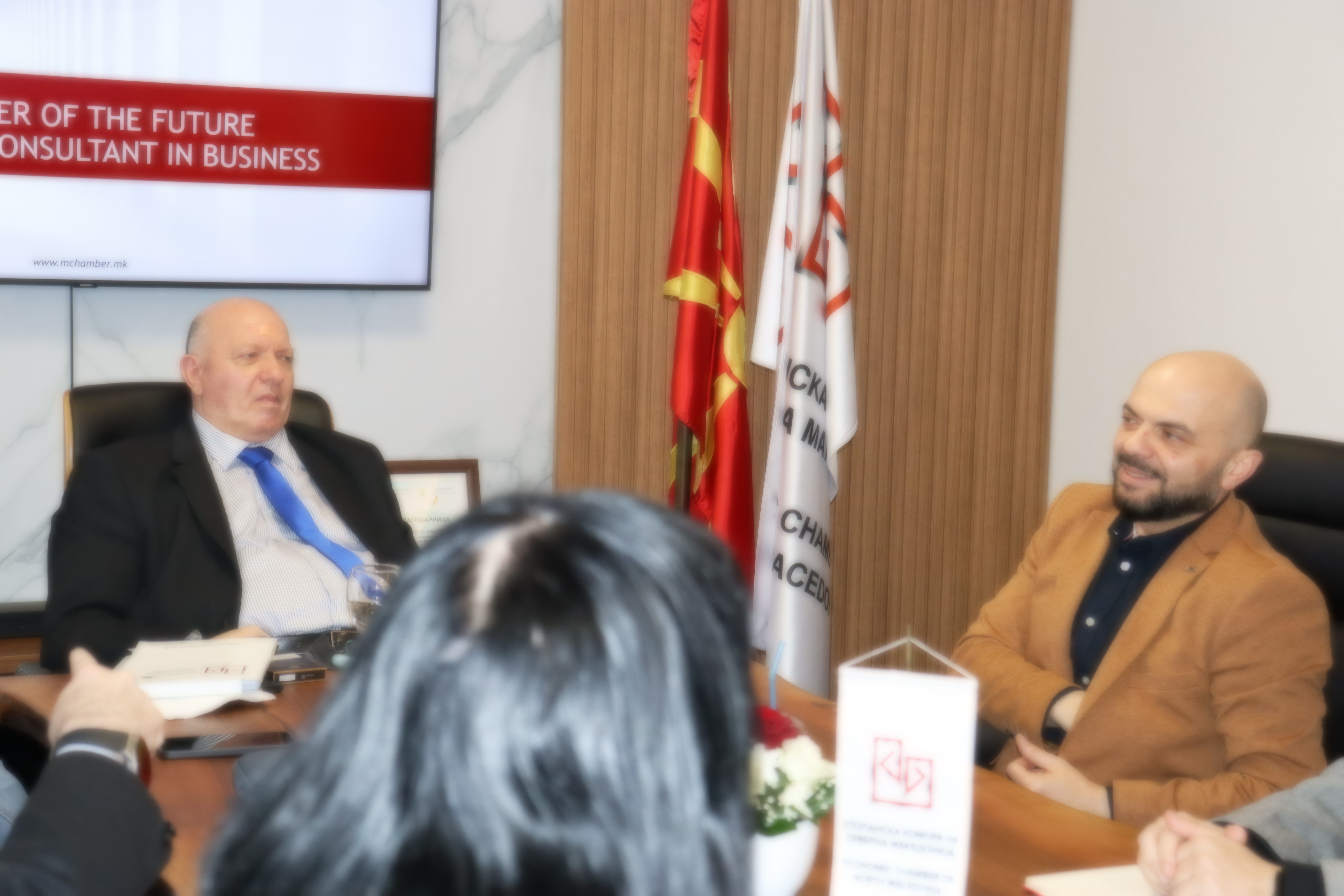
The success of Macedonian scientists beyond the country’s borders is well known, both in the region and more broadly. In this context, a new product developed by Macedonian Prof. Nikola Rendevski, from the Faculty of Information and Communication Technologies at the St. Kliment Ohridski University (UKLO) in Bitola, was presented at the premises of the Economic Chamber — a virtual simulator designed for the training of technical staff.
This type of digital virtual tool is of exceptional importance and provides valuable support in delivering part of workforce training, considering that both in the country and worldwide, one of the main challenges is not only the shortage of labor but also the level of professional expertise required for specific occupations. For example, the global demand for 250,000 welders illustrates the scale of the issue, with estimates indicating that this figure could reach 400,000 by 2030.
Over the past four years, the company Cythero has developed a product that meets numerous international standards and is already being used by several globally recognized manufacturers in the automotive, oil, and gas industries.
The product is a standalone control device that connects to an existing VR system and internet connection and, if needed, can also be linked to a video display or computer. The device itself contains an integrated internet connectivity system and software designed to generate the required virtual reality functionality.
To date, modules have been developed for two types of functionalities:
· Painting in the automotive industry.
· Welding (covering all three types of welding equipment).
The device provides a realistic recording of every parameter involved in the painting or welding process, delivering detailed data down to individual measurement units. This enables users to correct their performance and improve their production outcomes.
.jpg)
By using VR headsets, trainees can observe and adjust their movements, while instructors can simultaneously monitor the trainee’s work and provide guidance and instruction in real time during the training process.
This innovative digital solution, combining virtual reality with the practical application of technical knowledge, represents a new approach to acquiring practical skills and competencies outside a real working environment. It is particularly suitable for implementation in vocational schools and technical colleges, where practical skills for specific professions can be efficiently delivered.
.jpg)



 Progressive Academy