„Dimitrie Cupovski“ 13, 1000 Skopje +38923244000 ic@mchamber.mk
„Dimitrie Cupovski“ 13, 1000 Skopje +38923244000 ic@mchamber.mk
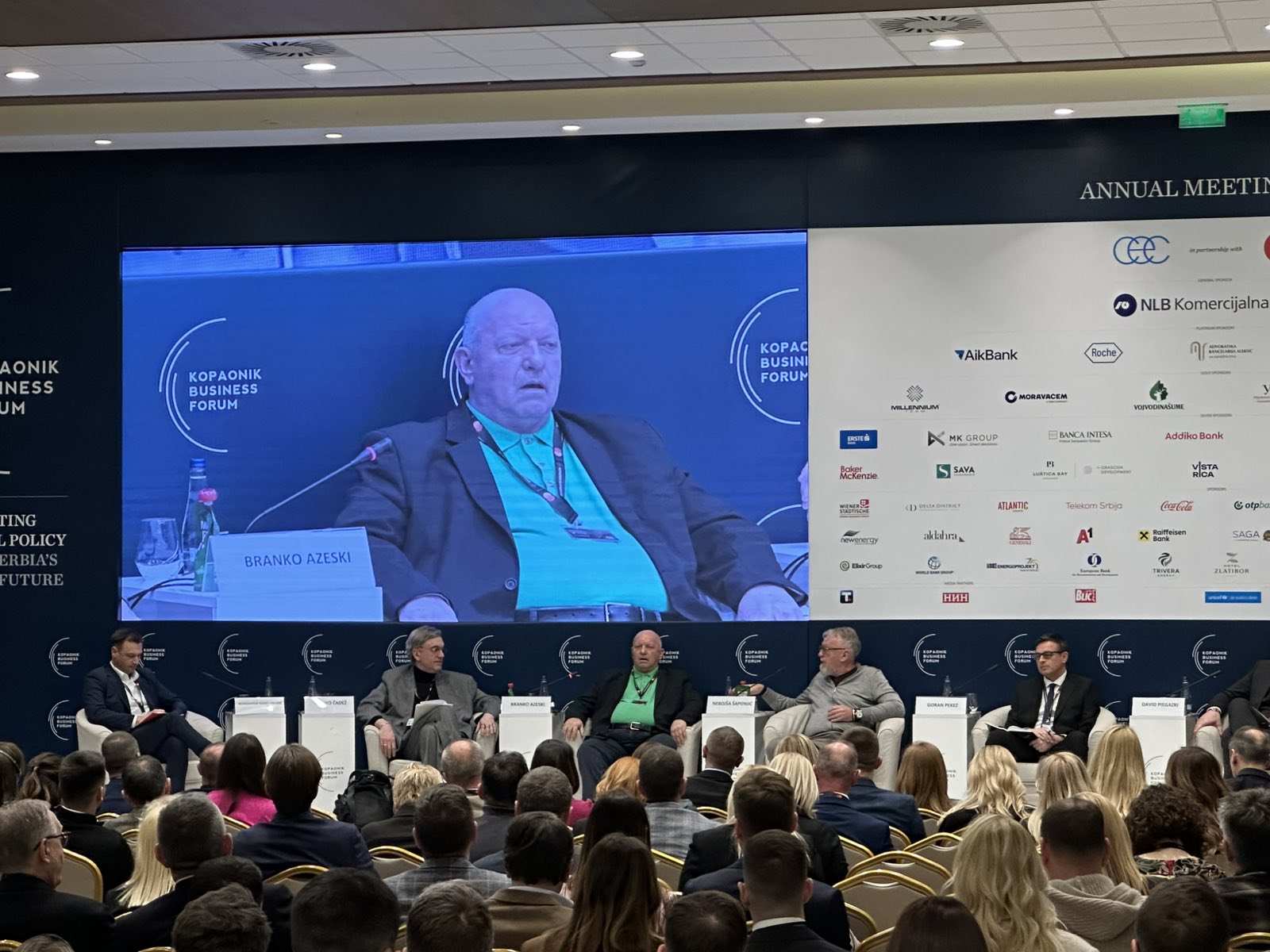
As part of this year’s activities at the 33rd edition of the Kopaonik Business Forum—the Balkan “Davos”—and across its 35 panel discussions, business leaders from the Western Balkans discussed the topic: “Together Forward: Western Balkans Regional Integration.” The focus of the discussion was on the effects of regional cooperation in trade and logistics, and how political relations in the region impact the economy, particularly through delays and disruptions in the flow of goods. The question was also raised as to how the region can act more strongly, competitively, and in a more coordinated manner toward the European Union and global investors.
(1).jpg)
The President of the Economic Chamber, Branko Azeski, emphasizing the need for fair relations and equal treatment of local and global investors, stressed that the private sector must have the space to lead economic cooperation processes and that business should ultimately be separated from politics. Economic and business relations, he underlined, can only support the development and prospects of the countries in the region, and never serve as an obstacle.
The panel also addressed issues at the borders with the European Union, particularly regarding the time transport operators spend in EU countries. It was noted that blockades are not a solution, as the damage from border closures in January reached approximately €90 million per day. It was concluded that progress in the EU integration process is visible, but it is long-term and requires constant adaptation. Continuous self-improvement and reforms are necessary wherever needed. Capital, it was emphasized, always finds its way to environments where there is stability and clear rules.
The panel was moderated by Aleksandar Radovanović, Head of the Center for Regional Cooperation at the Serbian Chamber of Commerce and Industry. In addition to President Azeski, participants included Marko Čadež, President of the Chamber of Commerce and Industry of Serbia; Dejan Mikerević from the Faculty of Economics at the University of Banja Luka; Goran Pekez, Corporate Affairs and Communications Director for the Western Balkans at JTI; David Piegazki, Secretary General of the Western Balkans 6 Chamber Investment Forum (WB6 CIF); and Nebojša Šaponjić, Co-Founder of Nelt Group.
(2)(1).jpg)
As part of the Kopaonik activities, President Azeski also participated in an event organized by the company “EXPO 2027,” together with business representatives and companies experienced in participating in world exhibitions. The discussion focused on how this international event can be leveraged for economic development and benefit the economy of the host country, while also generating positive effects for the wider region.
The Business Forum addressed current topics including macroeconomic policies, the digital economy, creative industries, artificial intelligence, regional cooperation, infrastructure, investment, innovation, banking and insurance, agriculture, green transition, healthcare, and education, as well as current global developments that strongly influence economic trends.
The high-profile Kopaonik Business Forum, organized in partnership with Mastercard, is hosted by the Serbian Association of Economists under the direct leadership of its President, Aleksandar Vlahović.
.jpg)



 Progressive Academy