„Dimitrie Cupovski“ 13, 1000 Skopje +38923244000 ic@mchamber.mk
„Dimitrie Cupovski“ 13, 1000 Skopje +38923244000 ic@mchamber.mk
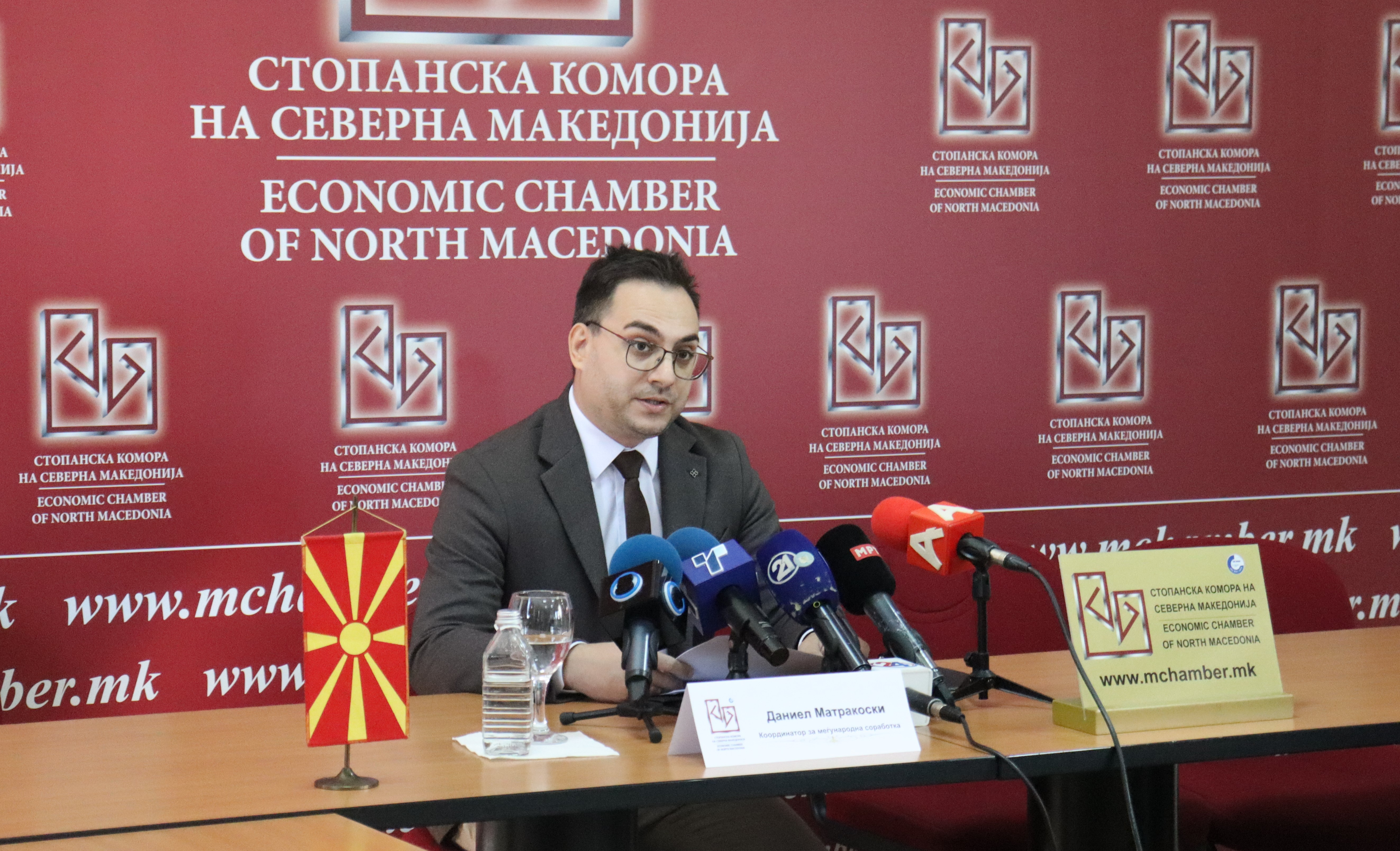
A press conference was held at the premises of the Economic Chamber dedicated to the intensified regional business dynamics and upcoming key events under the Montenegrin presidency of the Berlin Process. On behalf of the Chamber, the address was delivered by Daniel Matrakoski, International Cooperation Coordinator, who outlined the strategic initiatives and priorities of the chamber network aimed at supporting the domestic economy.
As Matrakoski highlighted, the Chamber’s focus remains anchored on three fundamental pillars: continuous support for export growth and promotion, education and vocational training aligned with real-world market needs through the dual education system, and deepening regional cooperation to establish a predictable business environment.
A central element in these efforts is the engagement of Chamber President Branko Azeski, who currently serves as President of the Western Balkans 6 Chamber Investment Forum (WB6 CIF)—a joint institutional platform representing over 350,000 enterprises. Matrakoski announced that at the upcoming Western Balkans Economy Ministers’ Meeting, scheduled for 30 September in Cetinje hosted by the Montenegrin Deputy Prime Minister Nik Gjeloshaj, President Azeski will be "the sole representative of the business community from across the entire Western Balkans to address this intergovernmental gathering." This represents an exceptional opportunity to present private-sector demands directly to line ministers and high-level officials from the European Commission.
Following the ministerial meeting, the EU–Western Balkans Business Platform will convene in Budva. Within this WB6 CIF framework, discussions will focus candidly on the implementation of the Growth Plan and the Common Regional Market, targeting the expansion of Green Corridors, the mutual recognition of phytosanitary documentation, and the urgent removal of non-tariff barriers.
Reflecting on economic indicators, Matrakoski pointed out that while trade with the EU exceeded €88 billion, the region runs a trade deficit of €14 billion. Concurrently, the regional industry faces a shortage of 190,000 workers, despite a latent pool of 2.8 million economically inactive citizens. To overcome these structural challenges, Matrakoski outlined five key development initiatives spearheaded by the WB6 CIF:
1. Ending Unfair Competition for Foreign Direct Investments (FDIs): Harmonizing investment incentives instead of engaging in subsidy bidding wars for the same foreign investors.
2. Integrating Domestic Firms as Primary Suppliers: Providing technical certification for local companies to secure higher domestic added value.
3. Stimulating Intra-Regional Investment: Establishing a tracking mechanism for intra-regional investments, which currently stand below 5%.
4. Training and Employing the Local Workforce to Address Labor Shortages: Utilizing the Regional Challenge Fund strategically to activate domestic human capital potential.
5. Direct and Swift Communication with Brussels: Maintaining an ongoing, operational dialogue with the European Commission to rapidly eliminate bureaucratic bottlenecks.
"The Berlin Process established the framework, but the critical next phase for the economy is practical economic connectivity. The objective is for the integration process to deliver real economic convergence, rather than merely formal institutional alignment," Matrakoski emphasized.


 Progressive Academy