„Dimitrie Cupovski“ 13, 1000 Skopje +38923244000 ic@mchamber.mk
„Dimitrie Cupovski“ 13, 1000 Skopje +38923244000 ic@mchamber.mk
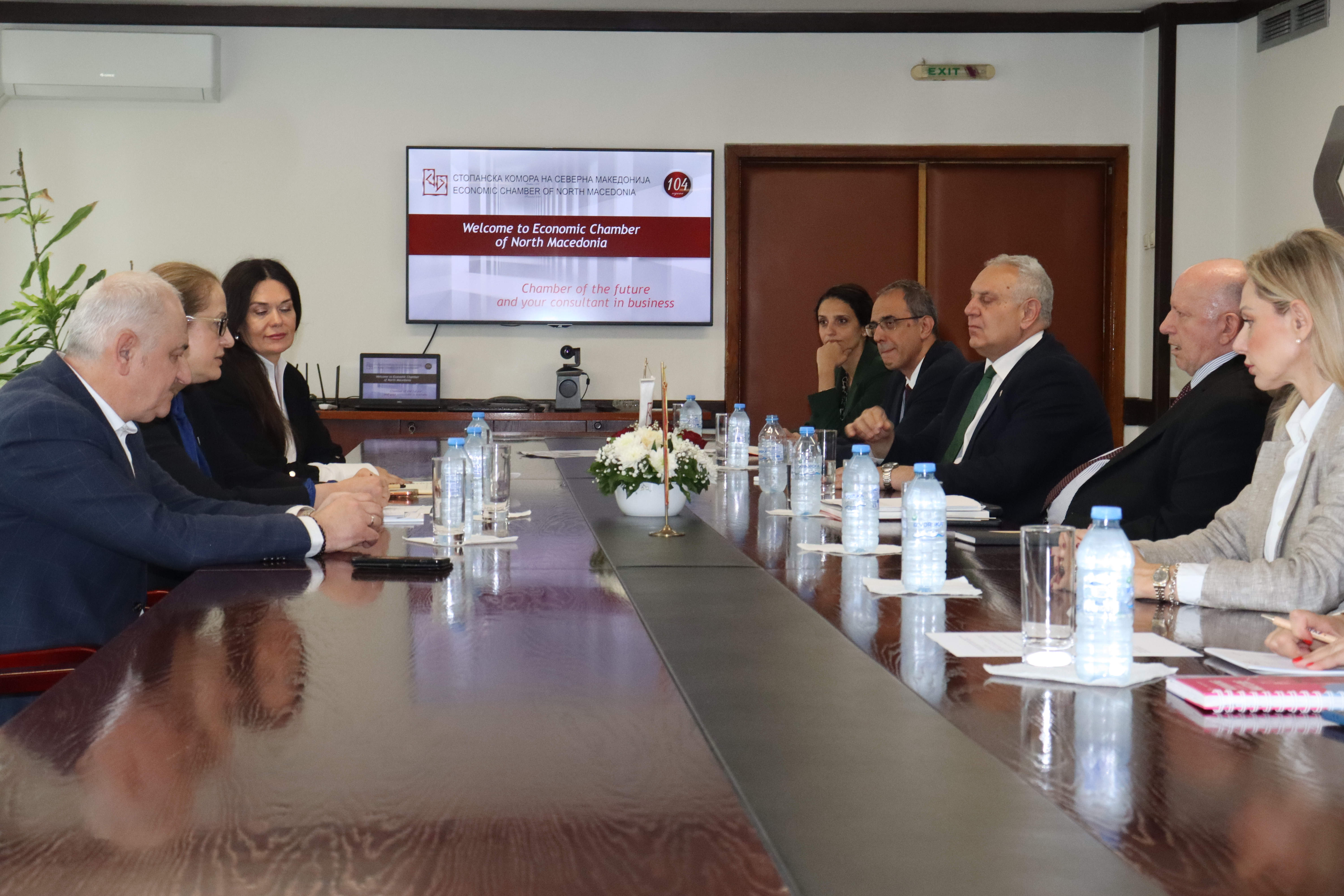
The President of the Economic Chamber, Branko Azeski, held a meeting with the President of the European Association for Quality Assurance in Higher Education (ENQA), Prof. Dr. Cristina Ghitulica. The meeting focused on the process of quality assurance in higher education, which represents one of the foundations for building a high-quality education system and requires adherence to the adopted standards and procedures.
“Quality assurance in higher education is a complex process because it encompasses multiple segments, but one of the most important aspects, alongside learning, teaching, and student-centered education, is the role of the business community,” emphasized Prof. Dr. Cristina Ghitulica during the meeting. One focus, she explained, is on study programs, which must be reviewed by the business community to ensure that the intended learning outcomes will be achieved through their implementation. The other focus is employability, meaning that the requirements of the business community are incorporated and that employers have confidence in the qualifications obtained.
“Quality assurance is a very important driver of change, sometimes even difficult ones, but it is crucial for the country to define how it wants to transform the system and what it aims to achieve through that transformation. Quality assurance is part of the Bologna Process, which means implementing the standards adopted within it. As a European quality assurance agency, we support the country in achieving its goals in the higher education quality assurance process so that Macedonia can move from associate membership to full membership in ENQA,” said Prof. Dr. Ghitulica.
President Azeski pointed out that, as the oldest organization in the country with a 104-year history—having survived two systems, three states, 12 prime ministers, and 18 ministers of education—and representing 17 sectors of business activity, the Chamber places education at the center of its work because the shortage of skilled labor has been a long-standing problem. According to Azeski, the reason for this lies in the fact that education failed to follow the changes taking place in the economy. “We must not allow this to continue, because we will lose the country,” Azeski stressed. That is why, he said, the Chamber has been working on this issue starting with vocational education, where tangible results have already been achieved, even though in 2015, when discussions on dual education began, there was resistance and difficulty in convincing companies that they too needed to contribute to educational processes and policies. Azeski added that the same approach has now been extended to higher education. With the support of ENQA, he noted, and through the introduction of standards and processes that everyone will respect, it will be possible to raise the quality of higher education, because business has no alternative.
.jpg)
From the business perspective, the quality of higher education is directly linked to productivity, competitiveness, and the long-term development of companies. Business does not measure quality by the number of diplomas awarded, but by the value employees create from their very first day at work—through applicable knowledge, skills aligned with real market needs, and the ability to adapt quickly and innovate.
For precisely this reason, only through a genuine partnership between education and the business community can one truly speak about quality and the development of a workforce that does not wait to be trained, but immediately contributes to the growth and competitiveness of the economy, while creating a system in which education is not isolated, but directly connected to the economy.
Prof. Dr. Cristina Ghitulica is a professor at the Polytechnic University of Bucharest and the first woman to assume ENQA’s highest leadership position since its establishment.
.jpg)



 Progressive Academy