„Dimitrie Cupovski“ 13, 1000 Skopje +38923244000 ic@mchamber.mk
„Dimitrie Cupovski“ 13, 1000 Skopje +38923244000 ic@mchamber.mk
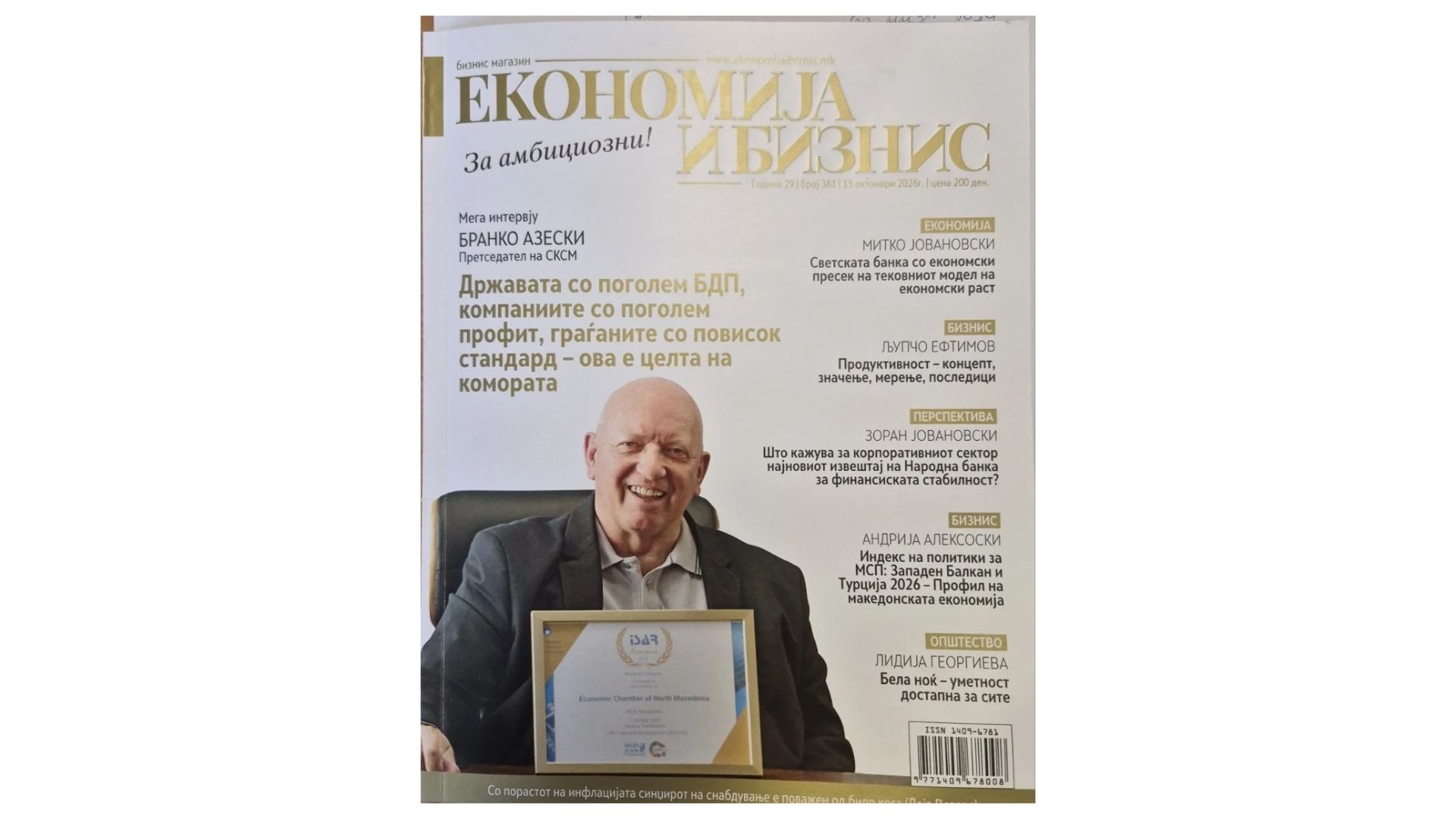
In the interview, President Azeski speaks about how failing to track trends means being pushed out of the game. That is not a new rule. We exist for the companies, for the members of the Economic Chamber. They have needs; we track them, adapt to new business currents, and meet them halfway so business can fulfill its purpose. We live in the 21st century, in an age of digitalization and artificial intelligence, which drives processes forward at immense speed. That is the very path along which business treads. It is no coincidence that we continuously receive international awards, points out the Chamber President.
He also addresses the fact that, as the leader of the country's most powerful and oldest business organization, they are acknowledged by relevant global bodies, yet not sufficiently recognized at home. As Azeski puts it, this is a "Balkan specialty" called spiteful envy. But he highlights: "I am resolved not to fight against that and not to waste time unnecessarily. That means WORK, WORK, AND ONLY WORK, tracking trends, building human capital, and launching daily initiatives."
Regarding the environment in which enterprises operate, he notes there is great potential, but there are also barriers. Distant markets entail high transportation costs, and without regional consolidation and scaling of products, there is no competitiveness. Potential export markets also exist across the Middle East and in parts of the EU where we lack presence. However, various forms of business barriers and competing interests hinder growth and the conquest of new export destinations. Adding to all this the fact that Macedonia has struggled for years with numerous unresolved issues stifling economic progress, we are left with only one course of action: rapid reforms at a fast pace, without concessions, to survive in a rapidly shifting world.
He also speaks about the need for reforms focused on two priorities: establishing the rule of law as quickly as possible and mastering the principles of a market economy. If we want competitive, innovative, and creative companies with potential for growth and expansion, fair competition and equal market treatment must be guaranteed. Translated into business language, this means demanding a definitive resolution to corruption and the grey economy. We demand a new Law on Public Procurement where domestic firms are prioritized, a state-of-the-art statistical recording system to serve as a baseline for shaping economic policy, a reduction of cash in circulation, electronic invoicing, and more, Azeski notes.
Macedonian export policy must shift away from conventional production incentives toward proactive, systemic backing for firms targeting foreign markets, scaling competitiveness, and generating higher domestic added value. Focus should center not solely on export volume, but on the goods exported, target destinations, and the share of economic value retained in Macedonia.
The overarching challenge is reaching economic development goals in the fastest manner possible. One clear avenue lies through foreign direct investment—regional or global—and opening new markets. The trajectories of regional, European, and global integration represent dynamic forces requiring continuous observation, strategic adaptation, swift responses, robust institutional capacity across public and private spheres, and entrepreneurial acumen. What currently represents an external market for Macedonia will soon become an internal market.
The Western Balkans 6 Chamber Investment Forum (WB6 CIF) plays a pivotal role in transitioning regional cooperation from political rhetoric into a concrete economic agenda, forging a truly integrated common regional market founded upon the four freedoms underpinning the EU Single Market.
From the standpoint of the Economic Chamber, regional economic integration is critical because our enterprises should view the Western Balkans not as six isolated markets, but as a shared regional market bound to harmonize with EU rules and incrementally integrate into the European Single Market as interrelated processes.
The WB6 CIF plays a distinctive role precisely within the push for deeper regional economic cooperation. Chambers are closest to enterprises and fastest at pinpointing the roadblocks that constrain regional commerce. Acting in unison, they can translate those bottlenecks into concrete recommendations for national governments and EU institutions. In this way, the business community is not merely a beneficiary of regional policy, but becomes an active architect through the WB6 CIF.
President Azeski shares that he makes a point of attending international forums, as they offer a single venue to convene with diverse peers, exchange perspectives, and forge networks. He notes that he feels most at home at the Kopaonik Business Forum, where he has participated as a panelist and trusted partner to the organizers for many years. He likewise takes part annually in the Vienna Economic Forum and the Economic Conference in Montenegro, while at the start of next year, plans are underway for him to lead a delegation for the first time to the world's most prestigious economic forum in Davos. He has also participated several times in the Crans Montana Forum, among various other global events.
The full interview will be available in the print edition of Economy and Business magazine.

 Progressive Academy