„Dimitrie Cupovski“ 13, 1000 Skopje +38923244000 ic@mchamber.mk
„Dimitrie Cupovski“ 13, 1000 Skopje +38923244000 ic@mchamber.mk
The Economic Chamber of North Macedonia proposes a new model for regulating non-working days, according to which every employee would be entitled to up to 13 or 14 non-working days during the year, with the option to choose a portion of the days for celebration. As part of the proposed amendments, it is also envisioned that a holiday falling on a Sunday would not be rolled over as an additional non-working day on Monday.
The draft amendments to the Law on Holidays will be submitted to the competent Ministry of Economy and Labor, with the aim of opening an institutional discussion on the possibilities for upgrading the existing system established in 2007.
The goal is to strike a better balance between the right to celebrate, equal treatment of citizens, and the need for the uninterrupted functioning of the economy.
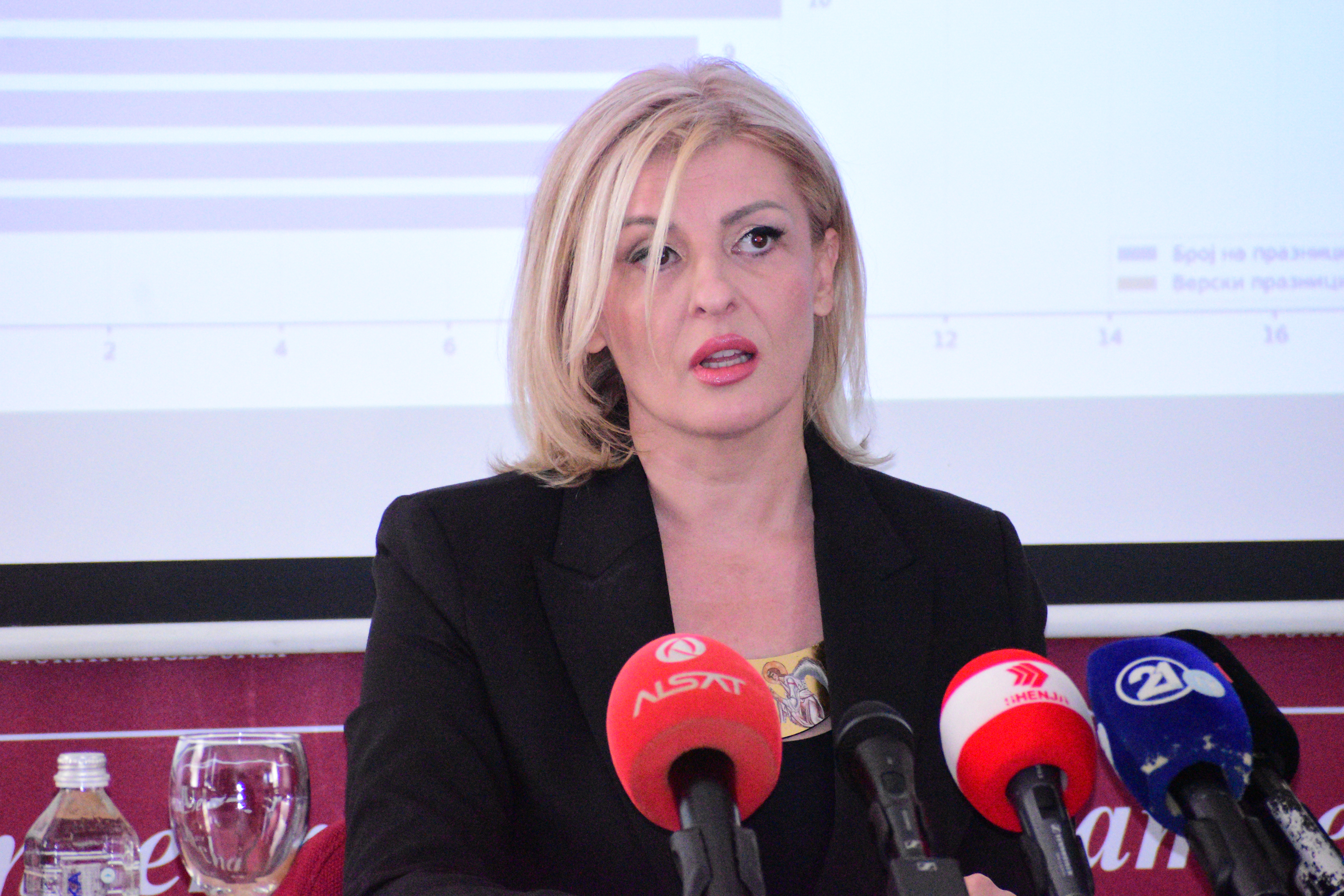
At a press conference at the Economic Chamber, Project Manager Aneta Dimovska pointed out that under the existing Law on Holidays, 11 non-working days apply to all citizens, while additional non-working days are designated for members of various religious and ethnic communities. Taking these additional days into account, the number of non-working days for certain categories of citizens can reach up to 16–17 days annually.
"The Chamber’s proposal does not mean abolishing holidays and the right to observe them, but rather changing the way they are used as non-working days. The goal is to create a more flexible and equitable model that will simultaneously enable greater predictability in work organization," Dimovska emphasized.
"The practical application of the Law over the past nearly two decades has resulted in an increase in the number of non-working days, including through additional days arising from religious holidays. This impacts economic activity, particularly workforce productivity, work process organization, and consumption. On days when companies, institutions, and factories are closed, there is a temporary reduction in production and the execution of business activities. This can lead to missed deadlines, reduced workload, and lower economic output. According to employer feedback and warnings, the private sector suffers losses manifested both as direct financial costs—due to higher holiday pay allowances and daily rates—and as indirect losses, stemming from the inability to fully operate and organize the workflow. Even when companies are prepared to work on a holiday and disburse higher employee allowances, their operations can be impeded or brought to a halt due to the absence of staff in state administration and specific service sectors, such as banks and other institutions on which business operations rely," Dimovska stated.
Under the proposed model, the holidays specified in Article 4 of the Law on Holidays would be working days, with each worker holding the right to choose two days from those designated as holidays to be treated as non-working days. This right to choose would be governed by the employment contract, which could also stipulate more than two non-working days from the legally established holidays. In this manner, equal access would be provided to workers of different religious and ethnic backgrounds. Instead of having the number of non-working days depend on membership in a specific religious or ethnic community, every employee could choose the days that carry personal, religious, or cultural significance for them.
This solution would reduce the total number of non-working days throughout the year and eliminate the automatic creation of extended holiday weekends. At the same time, it would reduce employer expenses tied to organizing work and paying holiday premiums, as well as mitigate losses caused by interruptions to production cycles and halted business activities.
Macedonia Compared to Other European Economies
According to an analysis of the number of holidays across European countries, in most of the examined economies, public holidays and non-working days range between 11 and 14 days.
Out of 36 analyzed economies, more than half—25 economies, or roughly 70%—have between 11 and 14 public holidays and non-working days. This points to a certain degree of convergence among the surveyed economies regarding the volume of non-working days.
If only the 11 nationwide non-working days applicable to all citizens are considered, Macedonia falls within this range. However, when factoring in the additional non-working days for religious holidays, particularly for Orthodox Christian citizens, the de facto count can reach 16, placing Macedonia among the economies with a higher tally of non-working days.
Furthermore, more than half of the analyzed European countries observe holidays on the calendar day on which they fall. This means that if a holiday falls on a Sunday or over the weekend, in a significant number of countries it is not transferred to the following working day, typically Monday.
With the proposed model, the Chamber aims to streamline the number of non-working days, secure greater flexibility for workers, and ensure equitable treatment for citizens of diverse religious and ethnic backgrounds. Simultaneously, the framework would help minimize disruptions to production and commercial processes, lower direct and indirect operational costs for employers, and establish greater predictability in workforce planning.
.jpg)



 Progressive Academy