„Dimitrie Cupovski“ 13, 1000 Skopje +38923244000 ic@mchamber.mk
„Dimitrie Cupovski“ 13, 1000 Skopje +38923244000 ic@mchamber.mk
“Productivity and efficiency are at an exceptionally low level. The solution lies in creating highly professional human capital with remuneration that corresponds to their competencies. If Macedonia fails to do this, it will continue exporting young people for a long time instead of creating a workforce that generates added value within the country,” stated the President of the Economic Chamber, Branko Azeski, at the conference titled “From Diploma to Competencies: The New Role of Universities Through Linking Academia and the Economy.”
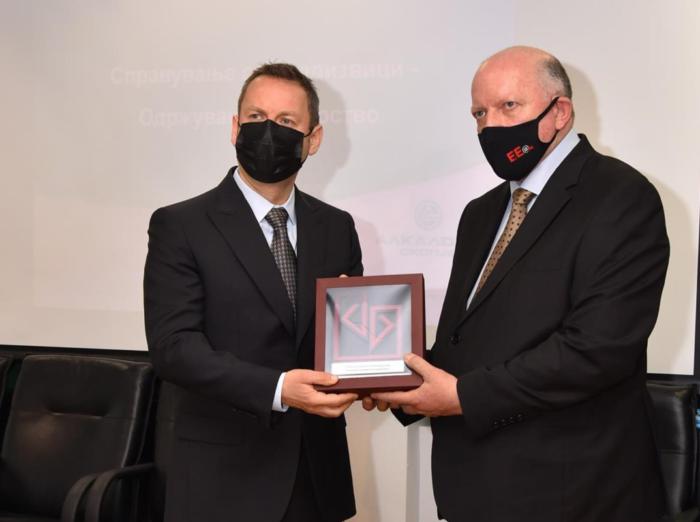
Organized by the Chamber, the conference aimed to bring together the views and experiences of the business sector, universities, and institutions and to open a constructive dialogue on the future of higher education and its role in the country's economic and social development. The event also served to promote the new composition of the Council for Higher Education and Strategic Research.
.jpg)
Azeski emphasized that it is of utmost importance for businesses to receive graduates through the education system who are useful in practice. Therefore, following the example of the dual model in secondary vocational education, efforts should also be directed toward developing a model for higher education.
“Higher education must become a partner of the economy and a driver of development. We need a new generation of engineers, technologists, IT experts, mechanical and electrical engineers, energy specialists, and others. We need practitioners, not only theorists. Over the next ten years, the winners will be the countries with productive industries, technological adaptability, homegrown innovation, and skilled professionals who create added value—and Macedonia must be among them. Higher education must become a development policy, not an administrative one,” emphasized Prof. Dr. Marjan Gjurovski, President of the Council for Higher Education and Strategic Research.
Representatives of the business community, members of the Economic Chamber and active participants in the conference, stressed that academia and business must not exist in completely separate worlds and that cooperation in the fields of education, science, and research is essential.
Dr. Risto Janevski from OKTA AD Skopje pointed out that companies must evolve in terms of understanding students’ expectations and improving working conditions. He highlighted the importance of greater student involvement in business processes during practical training so that they can better understand company operations and challenges, as well as the development of joint topics for undergraduate and graduate theses.
.png)
Viktor Mizo, MSc, from Kostal Macedonia DOOEL Ohrid, who received his education abroad, reflected on the significance of case studies and the practical resolution of real-sector problems during university studies. He also emphasized the importance of internships, particularly during the summer period, noting that at many foreign universities practical training is a prerequisite for enrollment in the following academic year. At the same time, he stressed the need for training university professors who serve as mentors.
Andrea Serafimoski from Granit AD Skopje noted that, following the example of dual education in secondary vocational schooling, if success is to be achieved, Macedonia should develop its own dual education model for higher education as well, while cooperation with the academic community remains a necessity.
During the conference, university representatives stated that cooperation with the business sector has intensified in recent years, but that this is still insufficient and new modalities for more constructive cooperation must be found.
Academician Izet Zekjiri stated that a major challenge would be strengthening cooperation between professors and the business community, as many professors lack business experience, there are few joint projects, and there is limited engagement in solving real business problems in which students and professors work together as part of the curriculum. He also highlighted the need to develop seminar, undergraduate, master's, and doctoral thesis topics in cooperation with the business sector.
In his remarks, he proposed a more intensive University–Business–Government interaction, whereby universities should adapt their programs to labor market needs, businesses should provide opportunities for practical training, and the Government should create fiscal and regulatory incentives for companies to employ young people and invest in research and development.






 Progressive Academy