„Dimitrie Cupovski“ 13, 1000 Skopje +38923244000 ic@mchamber.mk
„Dimitrie Cupovski“ 13, 1000 Skopje +38923244000 ic@mchamber.mk
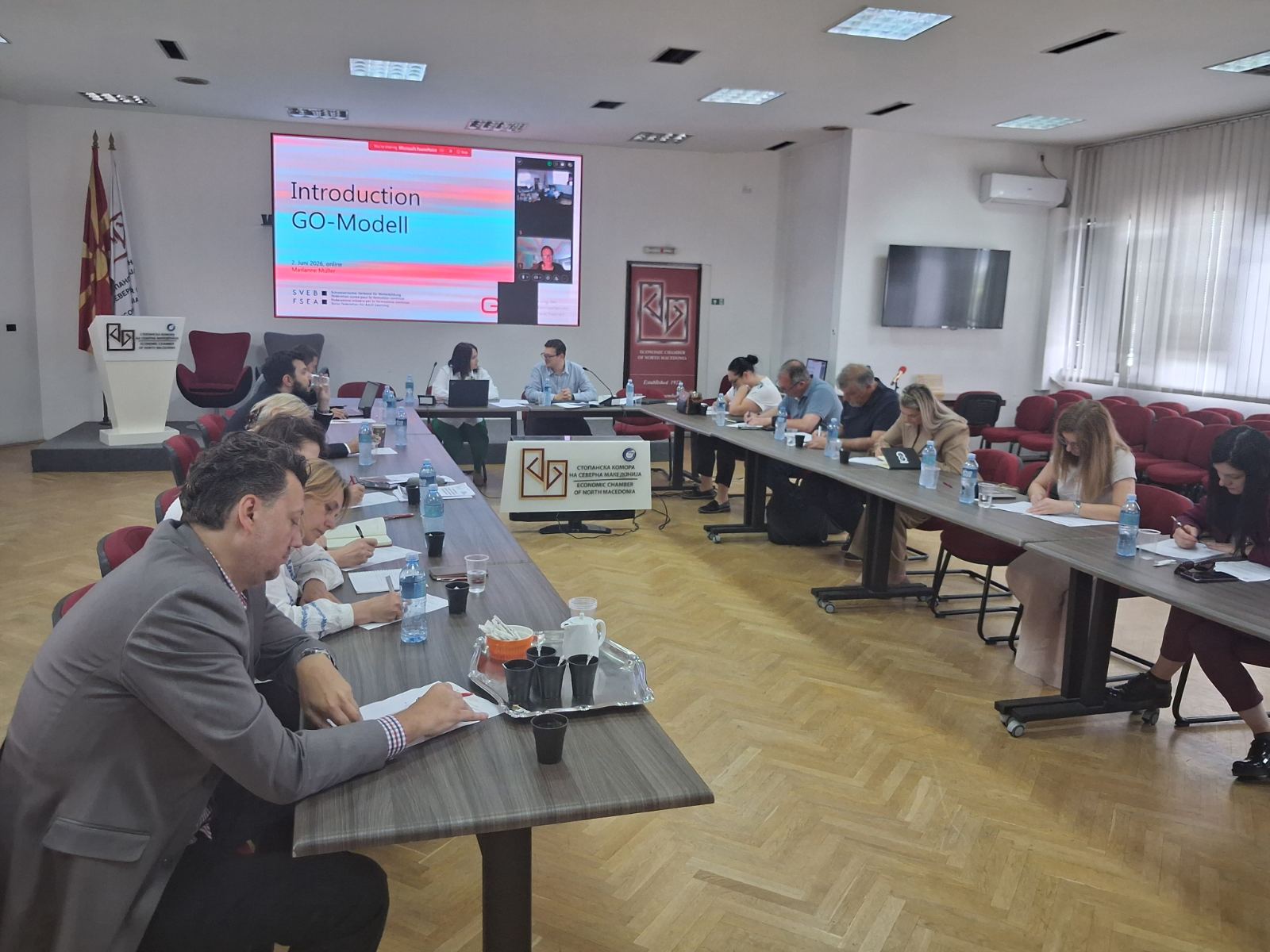
In line with efforts to improve knowledge on developing analyses for identifying the skills of existing employees and their upskilling, the Economic Chamber of North Macedonia, within the Education for Employment in North Macedonia project (E4E@mk), organized a workshop on the implementation of the GO-Model – Skills Forecasting and Upgrading Analysis.
The aim of the workshop was to familiarize persons responsible for HR policy implementation and human resource management in companies, coordinators of associations within the Chamber, and employees in regional chambers with the GO-Model. This model helps identify the knowledge and skills available within a company and their further development in line with job and business objectives, with the goal of improving production processes and overall company performance.
Based on previous participation in piloting the GO-Model, representatives of the Economic Chamber involved in the development of education policies for private sector skills needs also shared their experience.
(1).jpg)
Natasha Janevska, MA, Education Advisor in the Office of the President of the Economic Chamber, emphasized that the model is important for companies in identifying jobs and tasks, mapping existing employee skills, analyzing the skills gap for successful implementation of work processes, monitoring trends and future needs, preparing development plans through training programs for required skills and competencies for specific job roles, and ensuring continuous monitoring and updating, as the analysis is not a one-off process but must be regularly updated in line with changes in work processes.
The benefits of the GO-Model were presented by Mihajlo Donev, MSc, Assistant Operations Director for Development, Innovation, and Knowledge, who emphasized that it promotes a culture of learning and development through a systematic approach that connects individual and organizational capacities for building relevant professional skills aligned with modern trends, technical and technological changes affecting job transformation, as well as the development of soft skills that further contribute to organizational culture. He added that the model facilitates the identification of both current and future skill needs in the workplace and guides companies toward employee education and training for competency development.
(1).jpg)
Marianne Müller, Project Manager from the Swiss Federation for Adult Learning (SVEB), presented the GO-Model for identifying required skills and knowledge, aimed at their transfer in line with technological advancement within a qualification framework. The model essentially involves scanning tasks performed in a specific job and translating them into skills and key competencies for better understanding of job requirements, as well as defining new skills that will be in demand for the same position in the future.
In the second part of the workshop, representatives from the companies ZAVAR Company – Skopje, OKTA AD – Skopje, RUEN-Inox Automobile – Kochani, Comfy Angel – Prilep, and Laminati Kom – Prilep, together with association coordinators and regional chambers, worked on preparing Skills Development Plans to be implemented in their companies. This collaboration was initiated to better understand skills needs across companies from different sectors, in order to facilitate the transfer of sectoral insights into association-level activities.
.jpg)

 Progressive Academy